10,869 Marketing Apps, One Store: A Field Guide to Shopify's Most Crowded Category
MerchantPick tracks 10,869 marketing & conversion apps. That is not a category. That is a small city, and every resident is shouting that they will lift your revenue.
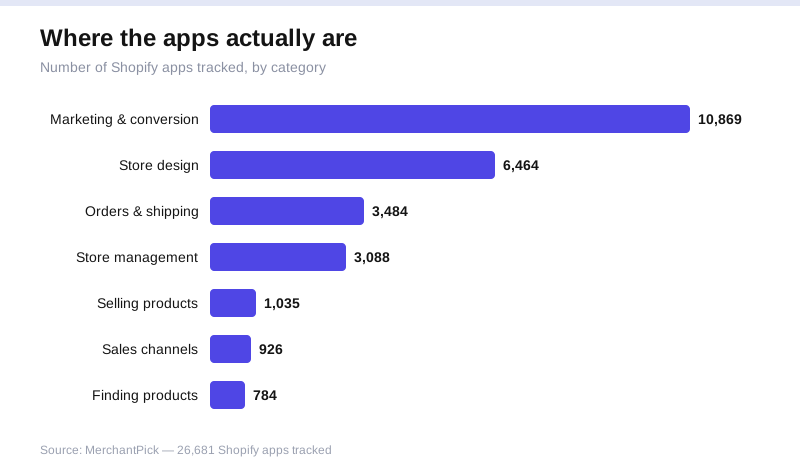
Put the number in context and it gets worse. We track 26,681 apps across the whole Shopify store. Marketing & conversion alone is 10,869 of them, so roughly two of every five apps that touch how you sell live in this one bucket. The next-biggest category, Store design, is 6,464. Orders & shipping is 3,484. Marketing does not lead the pack so much as it swallows it.
Here is the part most people get backwards. 65% of those 10,869 apps offer a free plan. Money is not your constraint. Your constraint is that dozens of these tools do the same job, describe it in the same words, and give you no honest way to pick. This guide is about picking anyway.
The problem is sameness, not scarcity
When a category has 3,000 apps, you can skim it. At 10,869 you cannot, and the store's search does not help, because the tools that rank are the ones best at ranking, not the ones best at their job.
The 65% free-plan figure is the real trap. It sounds like generosity. What it actually does is remove the one filter merchants instinctively reach for. If half the field cost real money up front, price would sort the list for you. Instead almost everything is free to install, so you end up judging on screenshots and review counts, both of which are gameable.
So throw out the flat list of 10,869. It is useless as a shopping surface. The only version of this category that makes decisions for you is the one broken into subgroups, because each subgroup pulls a different economic lever, and you do not need all the levers at once.
The five subgroups that actually matter
Underneath the 10,869 apps, five clusters do most of the real work. Each maps to a specific thing that makes you money:
Email & SMS pulls the repeat-revenue lever. It turns a one-time buyer into a second and third order.
Reviews & social proof pulls the trust lever. It answers the silent question every new visitor asks: has anyone been burned buying this.
Upsell & bundles pulls average order value. It grows the size of a sale you have already won.
Urgency & scarcity pulls the decision-nudging lever. Countdown timers, low-stock badges, cart pressure.
Loyalty pulls retention. Points, tiers, referrals, reasons to come back on purpose.
Almost every app in the category is a variation on one of those five moves. Once you can name which lever a tool pulls, the 10,869 stop looking like a wall and start looking like five shelves, most of which you can walk straight past today.
What earns its keep first
If you are choosing one app this quarter, choose from email & SMS or reviews. They pay back fastest, for opposite reasons.
Reviews win because they work on traffic you are already paying for. You are spending on ads or content to get someone to a product page. Social proof lifts the conversion rate of that existing visit, which means it improves the math on every other dollar you already spend. It is the cheapest thing you can do to make everything else perform better.
Email & SMS wins because it is the only lever on this list you fully own. Ad platforms rent you attention. An email list is an audience you keep. The first automated flows, a welcome series and an abandoned-cart sequence, tend to recover revenue that was otherwise gone. Start there before you touch anything clever.
Both have generous free tiers inside that 65%, so you can prove them out on your own numbers before committing. Judge them on your data, not their case studies.
What is overrated, and what to ignore
Urgency and scarcity apps are the most overrated corner of the 10,869. Not because the psychology is fake, but because it decays. A countdown timer that resets every time the page loads teaches shoppers to distrust you, and that distrust does not stay contained to the timer. Fake scarcity is a loan against your credibility. If you run genuinely limited drops, a scarcity tool is honest and it works. If you are inventing the pressure, skip the shelf entirely.
Loyalty programs are not overrated, but they are early-rated. A points program needs a base of repeat buyers to reward. Bolt one onto a store that has not yet proven people come back and you have built a frequent-flyer program for an airline with no regular flyers. Loyalty is a lever you pull after email has already created the repeat customers, not before.
And ignore, hard, any app whose pitch is that it does all five jobs at once. The 10,869 count is inflated by suites promising email and reviews and upsells and loyalty in one install. They tend to do each one worse than a focused tool, and they make you a hostage. Migrating off a five-in-one is five times the pain.
A filter that cuts 10,869 down to a shortlist
You will never compare thousands of apps, so do not try. Run each candidate through four questions and let most of them fail fast.
Which single lever does this pull? If you cannot answer in one sentence, the app is confused about itself, and it will confuse your store. Skip it.
Does the free plan cover a real test, or just a demo? Inside that 65% with free plans there is a wide gap between a tier you can actually run a business on and a trial dressed up as a plan. Read the limits, not the label.
What does it do to my storefront speed? Marketing and conversion apps inject scripts onto pages you are paying to send traffic to. A reviews widget that adds two seconds of load can erase the conversion lift it promised. Test with the app on and off.
How hard is it to leave? Email lists, review histories, and loyalty balances are data you should be able to export. If leaving means losing that, you are not choosing an app, you are choosing a landlord.
Four questions turn 10,869 into three or four names worth a real trial.
The short version
Marketing & conversion being the largest category MerchantPick tracks, at 10,869 of 26,681 apps, is not a signal that you need more of these tools. It is a warning that the sameness is the whole problem, and that the 65% free-plan rate means budget will not rescue you from it.
Name the lever before you install anything. Start with reviews and email, because they pay back on traffic and audience you already have. Hold off on loyalty until you have repeat buyers to reward, treat urgency tools as a credibility loan, and walk past anything that claims to be all five shelves at once. Do that and the biggest, loudest category in the store becomes a short list of three or four honest candidates. Which is the only version of it worth your time.


