When 65% of Shopify Apps Have No Reviews, You Need a Different Playbook
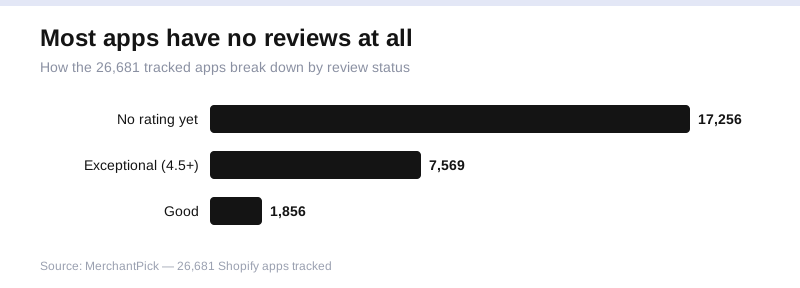
Here is the number that should change how you install software on your store: of the 26,681 Shopify apps we track at MerchantPick, 17,256 of them — roughly 65% — carry no rating at all. Not a low rating. None. If you browse any category deeper than the first screen of results, you will keep colliding with apps that have no public track record whatsoever.
That wrecks the standard advice. Every guide tells you to check the reviews before you install. Fine advice, except it only works on about a third of the catalog. For the other 17,256 apps, there is nothing to check. And the apps that do carry ratings are their own kind of trap, which I will get to. So the real skill is not reading reviews. It is judging an app that has no reviews to read, without getting burned.
The review signal is missing, and where it exists it is compressed
Start with the shape of the data, because it explains why your instincts fail here.
Two out of three apps are unrated. That is the headline, and it is not a temporary gap that fills in over time — the long tail of Shopify apps is enormous, most of these tools serve a narrow niche, and they will likely never accumulate enough installs to gather a meaningful rating. Waiting for reviews to appear is not a strategy. Many of these apps will still be reviewless a year from now.
Now look at the minority that are rated, because this is where people get overconfident. Among rated apps in our catalog, the scores pile up at the top: roughly 7,569 land in the 'exceptional' band versus about 1,856 that are merely 'good.' Read that ratio again. The best score is four times more common than a middling one. When almost everything that gets rated gets rated highly, the rating stops separating good from bad. A five-star average on a listing with eleven reviews from launch week tells you the developer's friends installed it. It does not tell you the app will still behave after your next theme update.
So you are working two problems at once. Most of the catalog gives you no rating, and the rated slice gives you a score so inflated it barely filters anything. Both roads lead to the same place: you need evidence that does not come from stars.
Permissions are the first thing to read, and usually the last thing people check
Before pricing, before the marketing copy, look at what the app asks to access. Shopify shows you the requested scopes on the install screen, and this is the single most honest thing about any app because the developer cannot fake it — the platform enforces it.
The rule is proportionality. A product-badge app that wants to read your full customer list and order history is telling you something. A shipping-rate calculator that requests write access to your theme and your customer PII is telling you something louder. Ask what the app actually does, then ask what it would minimally need to do that. When the gap between those two is wide, close the tab.
This matters more for unrated apps than for anything else, because with a rated app you at least have strangers who lived with it. With one of the 17,256 unrated apps, the permission list is often the only concrete, verifiable commitment the developer has made to you. Read it like a contract, because it is one.
Update recency separates a real product from an abandoned one
An app that has not shipped an update in eighteen months is a liability no matter how clean its listing looks. Shopify's platform moves. Checkout extensibility, theme architecture, API versions — they all shift on a schedule, and an unmaintained app quietly rots against them until one day it breaks your storefront and nobody answers the support email.
Check the last-updated date and the changelog. Frequent, boring maintenance releases are a green flag. They mean a human is still paying attention. For the huge unrated tail, this is often the cleanest proxy you have for whether the developer still exists as a going concern. A reviewless app that shipped a fix last week is a very different bet than a reviewless app frozen since the last API version. Same zero rating, opposite risk.
Pricing transparency is a character test
How an app presents its price tells you how it will treat you as a customer. You want the full pricing on the listing: the tiers, the metered charges, what happens when you cross a usage threshold, and what the free plan actually withholds.
Be suspicious of 'free' that turns out to gate every useful feature behind a wall you only discover after installing, and be more suspicious of pricing that is simply absent — 'contact us' for a $19 utility is a tell. Vague pricing on a rated app is annoying. Vague pricing on one of the reviewless 17,256 is a compounding risk, because you have no crowd to warn you about the surprise charge that lands on invoice three.
Clear, boring, itemized pricing correlates with developers who plan to stick around and bill you fairly. It is a cheap signal and a reliable one.
Support responsiveness and storefront impact, tested before you commit
Two things you can measure yourself, for free, before the app ever touches your live store.
First, poke the support channel. Send a real pre-sales question — something specific about a scope or a plan limit — and time the reply. A developer who answers a stranger's question thoughtfully in a day is a developer who will answer you when something breaks at checkout. Silence now is silence later. For an unrated app this is the closest you can get to manufacturing the review that does not exist: you are running your own one-person test and reading the result.
Second, measure the performance cost. Install it on a development store or a duplicate theme, not production, and check what it injects. Does it load a heavyweight script on every page when it only needs to run on the cart? Does your Lighthouse score drop? Storefront apps that bloat every page hurt conversion in ways no rating captures, and plenty of the exceptional-rated apps are quietly guilty of it too. This test does not care what band the app scored in. It just shows you the bytes.
A working method for the long tail
Put it together into something you can run in twenty minutes. Read the requested permissions and reject anything disproportionate. Check the last-updated date and skip anything stale against the current API. Confirm the full pricing is visible and itemized. Fire one real question at support and see what comes back. Then install on a non-production theme and measure the performance hit before it ever reaches a customer.
None of those five checks needs a single review, which is the entire point, because 17,256 of the 26,681 apps we track will never give you one. And do not exhale just because an app sits in the 7,569-strong 'exceptional' pile — with the top band outnumbering the merely-good roughly four to one, that badge is a weak filter carrying more weight than it earns. Treat every install as unproven until your own checks say otherwise. The merchants who get burned are the ones who outsourced the judgment to a star rating that, for two-thirds of the catalog, was never there to begin with.


