The 65% Trap: What a Shopify "Free Plan" Actually Costs You
Sixty-five percent of Shopify apps offer a free plan. That's 17,222 of the 26,681 apps we track, and it is the single most misleading statistic in the app store.
Not because the number is wrong. It's exactly right. It's misleading because "offers a free plan" and "is free to run your store on" are two completely different claims, and app listings blur them on purpose. A free plan is a doorway. What matters is what the room on the other side charges you once you're standing in it.
Free plan is a marketing term, not a price
Start with the honest version of the 65% figure. Of 26,681 apps, 17,222 have a tier priced at zero. Install one and you might pay nothing for years. Install another and the zero-dollar tier expires the moment you cross 50 orders, or 1,000 emails, or one connected sales channel — after which the real price sheet appears.
Three mechanics do most of the damage. Usage caps put a ceiling on the free tier: fine at launch, a wall at scale, and the wall always arrives exactly when the app has become load-bearing in your workflow. Per-order fees look tiny in the listing and compound viciously — a few cents an order is nothing at 20 orders a day and a real line item at 2,000. And paywalled features gate the one thing you installed the app to do: the free plan sends the email, the paid plan lets you segment who gets it.
So the useful question is never "is there a free plan." It's "which of these three is hiding in it."
Generosity is a category trait, not an app trait
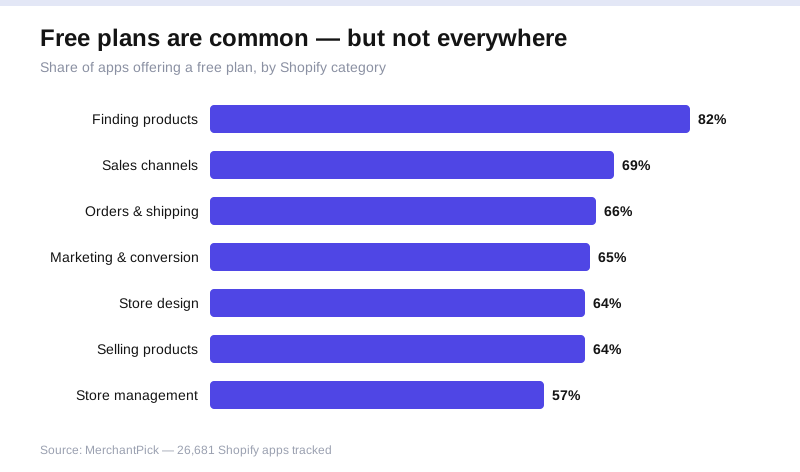
Here's where the aggregate 65% falls apart, and where it gets useful. Split those 17,222 free-plan apps by category and the spread is enormous.
Finding products leads at 82% of apps offering a free plan. Store management sits dead last at 57%. That's a 25-point gap between the most generous corner of the store and the stingiest, and it is not random.
The middle tells the same story in order: Sales channels 69%, Orders and shipping 66%, Marketing and conversion 65%, Store design 64%, Selling products 64%. Marketing and conversion landing right on the 65% average is almost poetic — it's the exact center of the store's pricing psychology.
Why does Finding products hit 82%? Because that category — dropshipping suppliers, sourcing tools, product importers — makes its money downstream. The app is free because it takes a cut of the products, the shipping, or the order volume it routes to you. The zero on the label is subsidized by a transaction you'll make later. Free at the door, metered in the aisle.
Why store management is the honest 57%
Store management being the stingiest category at 57% is the most reassuring number in this whole dataset, and I'd trust that corner of the store more for it.
Think about what lives there: bulk editors, backup tools, staff permissions, inventory sync, migration utilities. None of it has a downstream cut to take. There's no product to mark up, no order to skim, no shipping label to tax. The only way those developers eat is a subscription, so 43% of them don't bother pretending otherwise — they charge from day one.
A category where fewer apps dangle a free plan is a category where the ones charging you are at least being direct about the transaction. When a backup tool asks for $15 a month up front, you know the deal. When a sourcing app asks for nothing, you should be asking where the money actually comes from — because it comes from somewhere.
When a paid plan is the cheaper option
Paying up front is frequently the frugal move, and merchants talk themselves out of it to protect a monthly number that was never the real cost.
Per-order fees are the clearest case. Run the arithmetic against your actual order volume, not your launch-week volume. An app charging a flat $29 a month beats one charging 30 cents an order the instant you clear roughly 97 orders in a month. Below that, the free-ish metered plan wins. Above it, you're paying a tax to avoid a subscription, and the tax grows with the business while the subscription doesn't.
The second case is the feature gate that sits on your revenue. If the free plan does 90% of the job but paywalls the 10% that actually converts — the abandoned-cart flow, the upsell block, the review request — then the free plan isn't free. It's a discount on lost sales. A conversion app that recovers even a fraction of a percent of checkout will clear a $50 monthly fee before you've finished reading its billing page.
And there's the quiet cost nobody lists: your time. A free tier that caps you at one automation means you do the other twenty by hand. That labor doesn't show up in the app's pricing, but it shows up in your week.
How to actually read a listing
A short routine, applied before every install, saves more money than any single app choice.
Find the cap first. Every free plan has a number attached — orders, contacts, products, seats, SKUs — and that number is the plan. Locate it, then project three to six months out at your current growth rate. If you'll blow past it by autumn, price the tier you'll actually be on, not the one you're signing up for.
Hunt the per-order or per-transaction fee second. It's usually in smaller type than the monthly figure, which tells you which one the developer expects to make money on. Multiply it by a realistic monthly order count. If that product is bigger than the next paid tier's flat fee, the "free" plan is the expensive one.
Check what's gated third. If the specific feature that made you install the app lives behind the paywall, the free tier is a trial with no clock on it. Treat it as a trial and decide accordingly.
Run those three checks and the 65% stops being a comfort blanket. It becomes 17,222 individual pricing puzzles, most of which you can solve in two minutes.
The takeaway
The 65% headline invites exactly the wrong instinct — install free, defer the decision, worry about cost later. Later is precisely when free plans are built to charge you, because that's when you can't easily leave.
Use the category signal as your first filter. A free plan in Finding products, where 82% offer one, deserves the question "what's the downstream cut." A paid-only tool in Store management, where 43% skip the free tier entirely, deserves the question "is $15 a month cheaper than my time." Both questions have answers. Neither is answered by the word "free."
Across all 26,681 apps, the ones worth paying for share a trait: the paid plan costs less than the problem it removes. Do that subtraction before you install, not after the cap hits.


